Car Loan Interest Rates 2026: Average Auto Loan Rates by Credit Score and Term
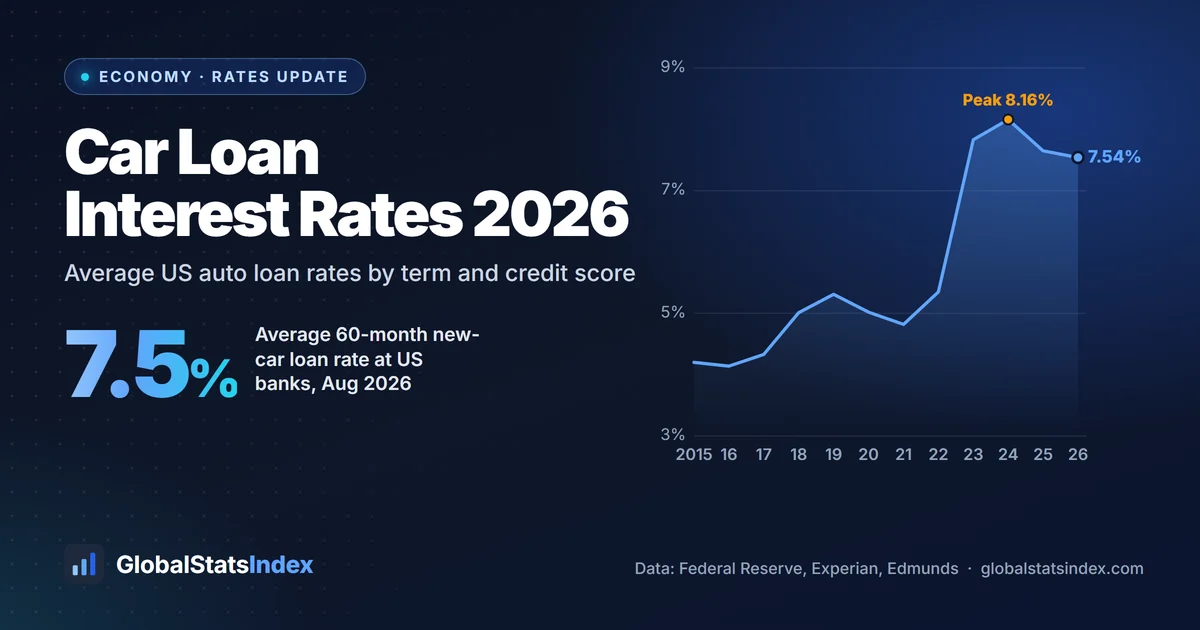
The average interest rate on a new-car loan in the United States is about 7% to 7.5% in 2026. Banks charged an average of 7.54% on 60-month new-car loans and 7.17% on 72-month loans in August 2026, according to the Federal Reserve. Across all lenders, including carmakers’ own finance arms, the average new-car APR was 6.35% and the average used-car APR was 11.19% in the second quarter of 2026. The rate you are offered depends most on your credit score, the loan term and whether the car is new or used.
Key takeaways
- US banks charged 7.54% on 60-month new-car loans in August 2026, down from a peak of 8.16% (annual average) in 2024 but well above the 4.82% of 2021.
- The average new-car APR across all lenders was 6.35% and the average used-car APR 11.19% in Q2 2026.
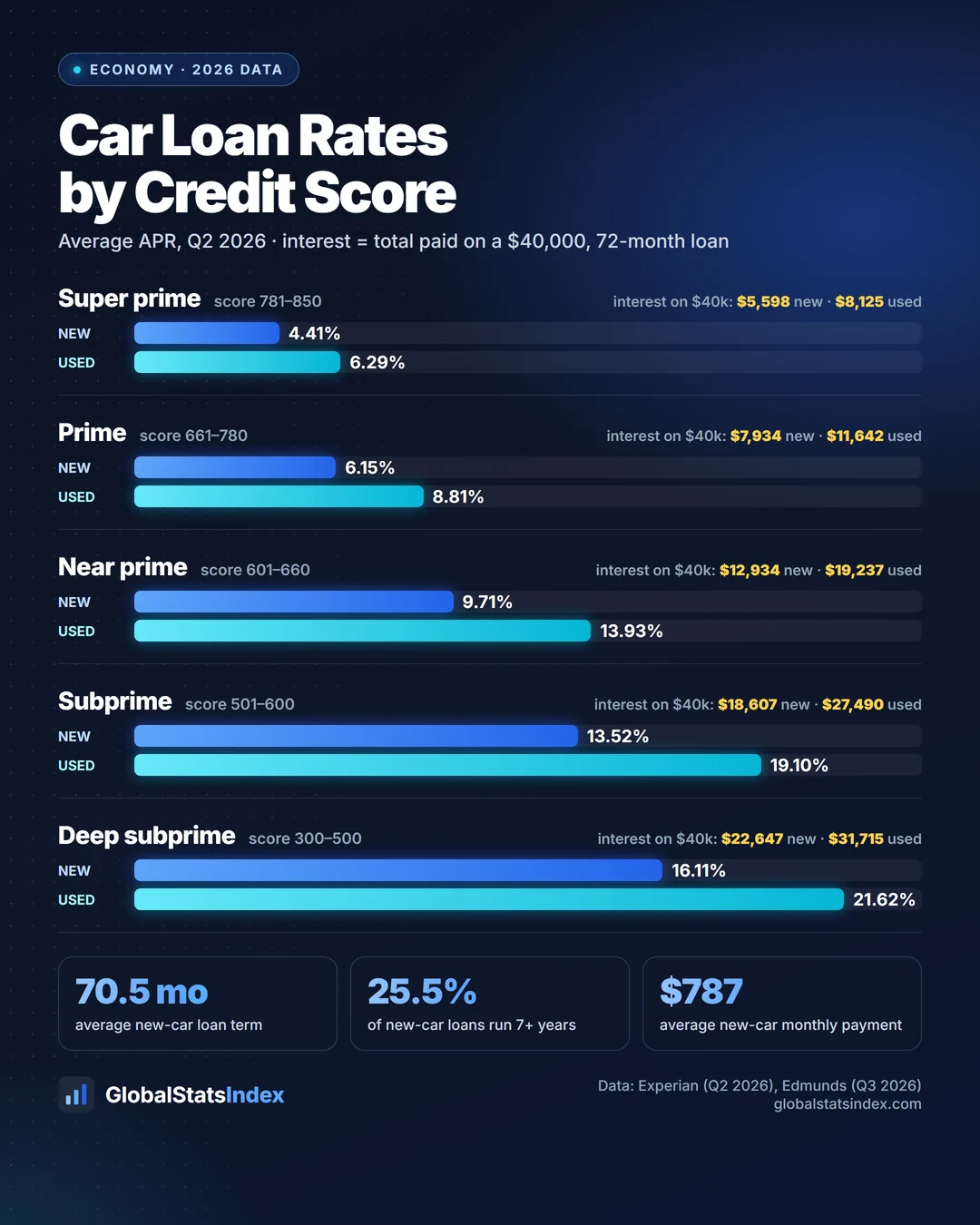
- Borrowers with super prime credit (781+) paid 4.41% on new cars; deep subprime borrowers (300–500) paid 16.11% new and 21.62% used.
- The average new-car loan now runs 70.5 months, and 25.5% of new-car loans last 84 months or longer.
- The average new-car payment hit a record $787 a month in Q3 2026 on an average loan of $44,664.
Current car loan interest rates (2026)
The Federal Reserve surveys commercial banks every quarter on the rates they charge for new-car loans. In the August 2026 survey, the average rate was 7.47% for a 48-month loan, 7.54% for 60 months and 7.17% for 72 months. Edmunds, which tracks financed purchases at dealerships, put the average new-car APR at 7% in the third quarter of 2026, unchanged from a year earlier.
| Loan type | Average rate | Period | Source |
|---|---|---|---|
| New car, 48 months (banks) | 7.47% | Aug 2026 | Federal Reserve G.19 |
| New car, 60 months (banks) | 7.54% | Aug 2026 | Federal Reserve G.19 |
| New car, 72 months (banks) | 7.17% | Aug 2026 | Federal Reserve G.19 |
| New car, all lenders | 6.35% | Q2 2026 | Experian |
| Used car, all lenders | 11.19% | Q2 2026 | Experian |
| New car, dealer-financed purchases | 7% | Q3 2026 | Edmunds |
Why do the figures differ? The Federal Reserve number covers loans made directly by banks. The Experian average includes captive lenders, the finance companies owned by carmakers, which often subsidize rates to move inventory, sometimes down to 0% for buyers with excellent credit. Those promotional deals lower the all-lender average for new cars, while used-car loans, which rarely get such incentives, cost far more.
How car loan rates have changed since 2015
Car loan rates jumped after 2021 and have barely eased
Average finance rate on new-car loans at US commercial banks, annual average of quarterly readings (2026 = Feb–Aug).
- 60-month loan
- 72-month loan
Car loan rates track the Federal Reserve’s policy rate with a lag. Through the late 2010s, a 60-month new-car loan at a bank cost about 4% to 5%. Rates fell to 4.82% in 2021, when policy rates were near zero, then jumped as the Fed raised rates to fight inflation: to 7.83% in 2023 and a peak annual average of 8.16% in 2024. They have eased only slightly since, to an average of 7.40% across the 2026 readings so far.
Car loan rates by credit score
Credit score is the biggest single factor in the rate a lender offers. Experian’s data for the second quarter of 2026 shows the gap between the best and worst credit tiers is about 12 percentage points for new cars and more than 15 points for used cars.
What rate will you get? It depends on your credit score
Average APR by credit tier, new vs used cars, Q2 2026 (VantageScore 4.0 bands).
- New car
- Used car
| Credit tier | Score range | New car APR | Used car APR |
|---|---|---|---|
| Super prime | 781–850 | 4.41% | 6.29% |
| Prime | 661–780 | 6.15% | 8.81% |
| Near prime | 601–660 | 9.71% | 13.93% |
| Subprime | 501–600 | 13.52% | 19.10% |
| Deep subprime | 300–500 | 16.11% | 21.62% |
Those differences add up. On a $40,000 loan over 72 months, a super prime borrower at 4.41% would pay about $5,598 in interest, while a deep subprime borrower at 16.11% would pay about $22,647, and a monthly payment roughly $237 higher.
The real cost of a lower score
Total interest paid on a $40,000 loan over 72 months at each tier’s average new-car APR.
Used car loan rates
Used-car loans cost more at every credit level. The average used-car APR was 11.19% in Q2 2026, almost five points above the new-car average. Even super prime borrowers paid 6.29% on a used car, compared with 4.41% on a new one. Lenders charge more because used cars lose value less predictably, the loans are smaller and they are less often backed by manufacturer promotions. The best used-car rates go to buyers with scores above 780 who choose shorter terms.
How long are car loans?
The typical new-car loan is now close to six years. Edmunds puts the average term for financed new-vehicle purchases at 70.5 months in Q3 2026, and 25.5% of new-car loans ran 84 months (seven years) or longer. Common terms range from 36 to 84 months. Longer terms lower the monthly payment but raise total interest, and in the Federal Reserve data a 72-month bank loan currently costs about the same rate as a 60-month loan (7.17% vs 7.54%), so the extra year mostly adds interest rather than saving on the rate.
One in four new-car loans now lasts seven years or more
Share of financed new-vehicle purchases with terms of 84 months or longer, Q3 2026. Average term: 70.5 months.
- 84 months or longer
- Shorter than 84 months
Average monthly car payment
Higher prices, bigger loans and elevated rates have pushed payments to records. The average monthly payment on a financed new vehicle reached $787 in Q3 2026, up from $777 in the previous quarter and $756 a year earlier. The average amount financed was $44,664, and average lifetime interest on a new-car loan reached a record $9,938.
Monthly payments keep setting records
Average monthly payment on financed new vehicles.
Car loan rates at a glance
How to get a lower car loan rate
- Check your credit first. Moving from near prime to prime cuts the average new-car APR from 9.71% to 6.15% in the Experian data.
- Get pre-approved by a bank or credit union before visiting a dealer, so you can compare the dealer’s offer with a real alternative.
- Look for manufacturer promotions on new cars; captive lenders’ subsidized rates are the main reason the all-lender average sits below bank rates.
- Choose the shortest term you can afford. A shorter loan rarely costs a higher rate and saves substantial interest.
- Put more money down to reduce the amount financed and the lender’s risk.
Methodology
Bank rates come from the Federal Reserve’s G.19 Consumer Credit release, which reports the average finance rate on new-car loans at commercial banks each quarter; annual figures here are averages of the available quarterly readings. Credit-tier averages come from Experian’s State of the Automotive Finance Market and use VantageScore 4.0 bands. Payment, term and loan-size figures come from Edmunds’ quarterly analysis of financed new-vehicle purchases. Interest-cost examples are Global Stats Index calculations using standard amortization and exclude fees, taxes and add-ons. Rates are national averages, not offers.
Sources
- Federal Reserve, G.19 Consumer Credit: finance rates on new-car loans at commercial banks, 48, 60 and 72 months (series via FRED).
- Experian, average car loan interest rates by credit score, State of the Automotive Finance Market, Q2 2026.
- Edmunds, Q3 2026 new-car financing report (October 2026).