Japan Wood Pellet Imports: Volumes, Suppliers and Prices (2012–2026)
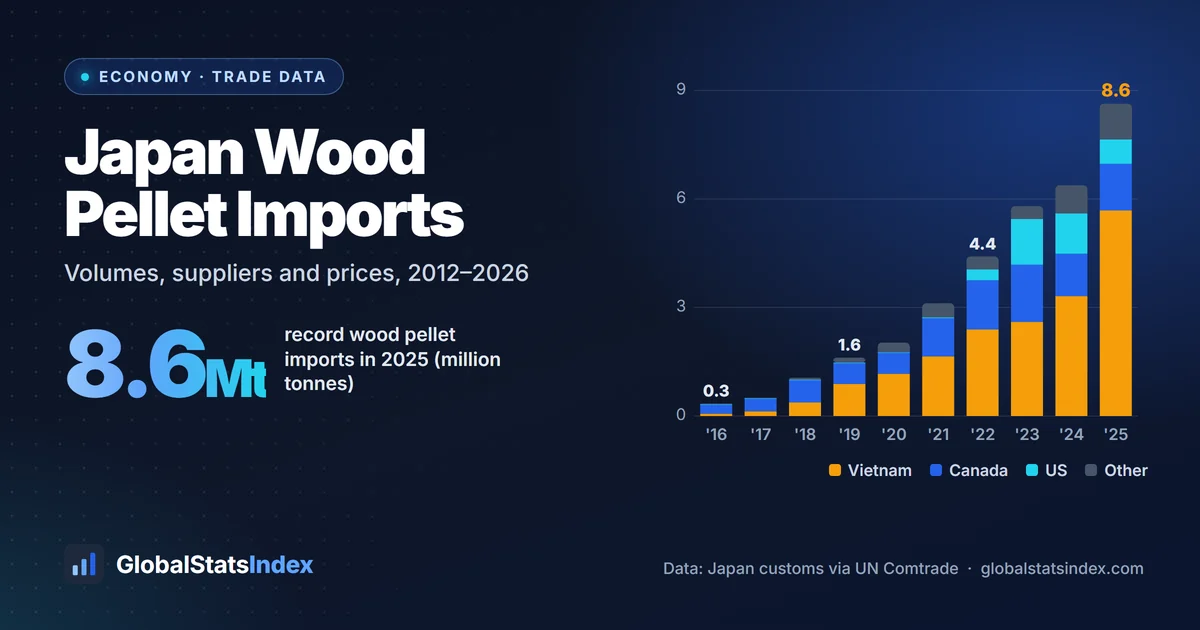
Japan imported a record 8.64 million tonnes of wood pellets in 2025, worth $1.68 billion, and about two-thirds of them came from Vietnam. Imports rose 35% from 6.38 million tonnes in 2024, according to Japan’s customs data. Vietnam shipped 5.68 million tonnes (66%), ahead of Canada (15%) and the United States (8%). Growth has continued in 2026: Japan imported 7.10 million tonnes from January to September, 10% more than in the same months of 2025. Almost all of it is burned in biomass power plants.
Key takeaways
- Japan imported 8.64 million tonnes of wood pellets in 2025, up 35% on 2024 and about 120 times the 72,000 tonnes of 2012.
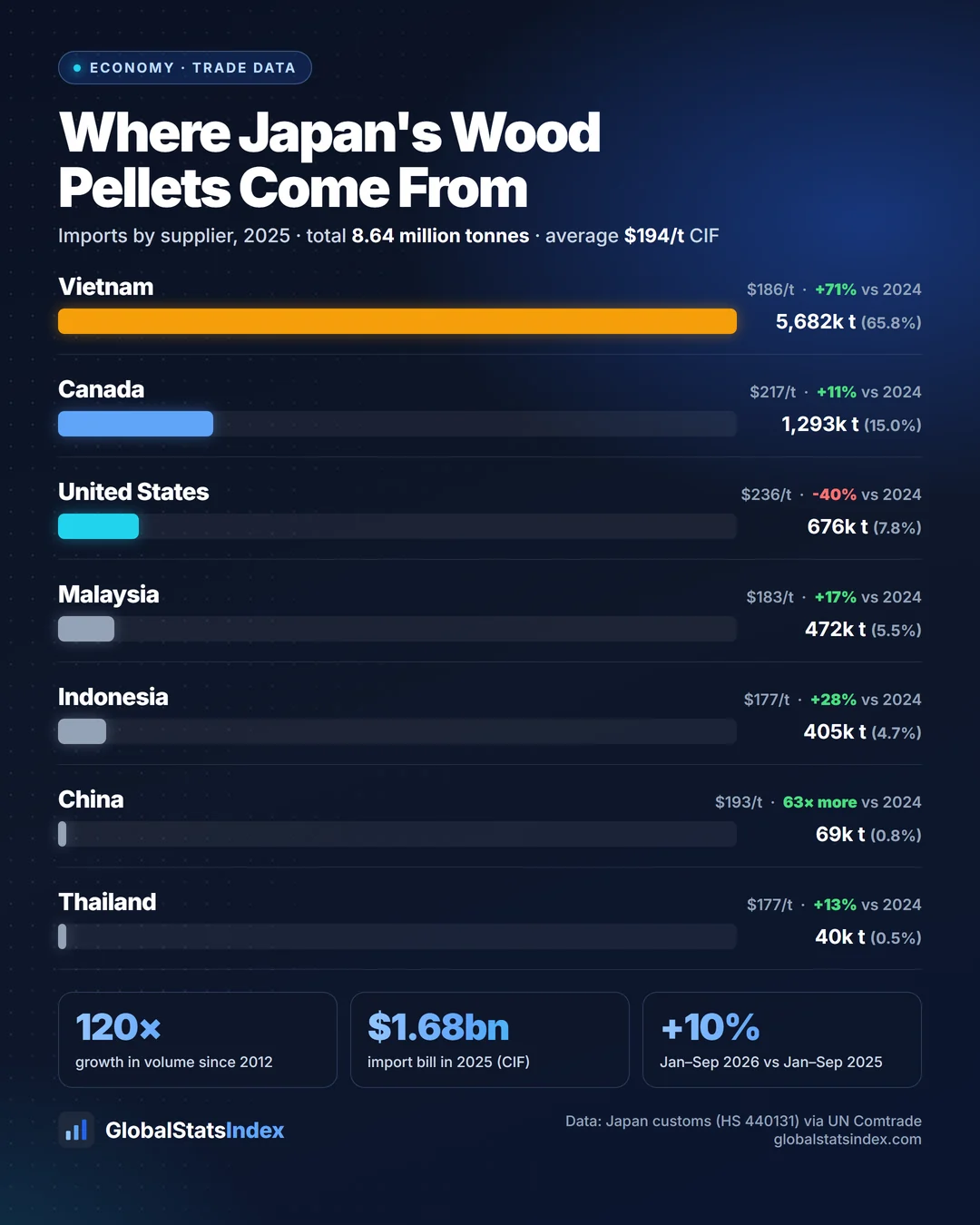
- Vietnam supplied 65.8% of the volume (5.68 Mt), followed by Canada (15.0%) and the United States (7.8%).
- The import bill reached $1,678 million in 2025 at an average CIF price of $194 per tonne, down from $198 in 2024.
- Vietnamese pellets were among the cheapest at $186/t; US pellets were the most expensive major supply at $236/t.
- January–September 2026 imports reached 7.10 million tonnes, up 10%, putting 2026 on course for a new record.
How much wood pellet does Japan import?
Japan is one of the world’s largest importers of wood pellets. Customs records show imports of 8.64 million tonnes in 2025, the highest on record, with a declared value of $1,678 million on a CIF (cost, insurance and freight) basis. The volume has risen every year since the wood pellet product code was introduced in 2012, and the pace picked up sharply after 2017, as large biomass power plants built under Japan’s feed-in tariff began operating.
Japan’s wood pellet imports have grown 120-fold since 2012
Annual wood pellet imports, million tonnes.
| Year | Imports (tonnes) | Change | Value (US$ million) | Avg price ($/t) |
|---|---|---|---|---|
| 2012 | 71,981 | — | 19.4 | 269 |
| 2013 | 83,769 | +16% | 20.0 | 239 |
| 2014 | 96,745 | +15% | 24.5 | 253 |
| 2015 | 232,425 | +140% | 45.6 | 196 |
| 2016 | 346,865 | +49% | 63.0 | 182 |
| 2017 | 506,369 | +46% | 87.3 | 172 |
| 2018 | 1,059,542 | +109% | 194.8 | 184 |
| 2019 | 1,614,037 | +52% | 285.3 | 177 |
| 2020 | 2,028,230 | +26% | 343.6 | 169 |
| 2021 | 3,116,780 | +54% | 562.4 | 180 |
| 2022 | 4,408,405 | +41% | 909.4 | 206 |
| 2023 | 5,803,374 | +32% | 1,262.0 | 217 |
| 2024 | 6,380,983 | +10% | 1,265.5 | 198 |
| 2025 | 8,637,659 | +35% | 1,677.9 | 194 |
Japan wood pellet imports by country
Seven countries supply almost all of Japan’s imported pellets. Vietnam has been the largest supplier since 2019, when it overtook Canada, and its lead widened dramatically in 2025: shipments rose 71% to 5.68 million tonnes. Canada, the original supplier to Japan’s biomass plants, shipped 1.29 million tonnes, up 11%. US shipments fell 40% to 676 thousand tonnes after two years above one million tonnes.
Japan’s largest wood pellet suppliers in 2025
Import volume by country of origin, thousand tonnes.
Two-thirds of Japan’s imported pellets come from Vietnam
Share of 2025 wood pellet import volume by supplier.
- Vietnam
- Canada
- United States
- Malaysia, Indonesia and others
| Supplier | 2024 (tonnes) | 2025 (tonnes) | Change | Share 2025 | Value 2025 (US$ m) |
|---|---|---|---|---|---|
| Vietnam | 3,315,260 | 5,682,059 | +71% | 65.8% | 1,059.6 |
| Canada | 1,166,602 | 1,292,701 | +11% | 15.0% | 280.0 |
| United States | 1,118,215 | 676,477 | -40% | 7.8% | 159.6 |
| Malaysia | 403,069 | 472,009 | +17% | 5.5% | 86.5 |
| Indonesia | 314,895 | 404,501 | +28% | 4.7% | 71.5 |
| China | 1,103 | 68,949 | 63× | 0.8% | 13.3 |
| Thailand | 35,129 | 39,634 | +13% | 0.5% | 7.0 |
| All suppliers | 6,380,983 | 8,637,659 | +35% | 100% | 1,677.9 |
How the supplier mix has changed
In 2014 Canada supplied 94% of Japan’s pellet imports. Vietnam’s exporters, using sawmill residues and fast-growing acacia and rubberwood plantations, grew from about 2,000 tonnes that year to 887 thousand tonnes in 2019, overtaking Canada. US producers entered the market late: shipments jumped from about 27,000 tonnes in 2021 to 1.26 million tonnes in 2023, when the US briefly supplied 22% of the total, before falling back in 2025. Malaysia and Indonesia have become steady secondary suppliers, and shipments from China rose from about 1,100 tonnes in 2024 to 69 thousand tonnes in 2025.
Vietnam supplied most of the growth
Wood pellet imports by supplier, million tonnes. Labels show the annual total.
- Vietnam
- Canada
- United States
- All others
Wood pellet import price in Japan by country
The average CIF price of Japan’s imported wood pellets was $194 per tonne in 2025, down from $198 in 2024 and a peak of $217 in 2023, when energy prices spiked worldwide. Prices differ by origin, mostly because of freight distance and contract terms. In 2025, pellets from Vietnam averaged $186 per tonne, Malaysia $183 and Indonesia $177, while Canadian pellets cost $217 and US pellets $236. Long-haul North American supply is typically sold on long-term contracts to large power plants, and it competes with Asian supply on certification and consistency rather than price.
Import price by country: US and Canadian pellets cost the most
Average CIF import price, US dollars per tonne (import value ÷ volume).
- 2024
- 2025
Wood pellet imports in 2026
Monthly customs data show Japan imported 7.10 million tonnes of wood pellets from January to September 2026, up 10.0% from 6.45 million tonnes a year earlier. The third quarter set a quarterly record of 2.57 million tonnes, up 9.4%, and July 2026 was the largest single month on record at 937,715 tonnes. Import value rose faster than volume, to $1,430 million (+13.7%), as the average price edged up; in the third quarter it was $206 per tonne, 5% higher than a year earlier.
2026 is on track for another record
Wood pellet imports by quarter, million tonnes, 2025 vs 2026.
- 2025
- 2026
| Supplier | Jan–Sep 2025 (tonnes) | Jan–Sep 2026 (tonnes) | Change |
|---|---|---|---|
| Vietnam | 4,209,683 | 4,523,897 | +7% |
| Canada | 993,093 | 893,310 | -10% |
| United States | 502,119 | 603,939 | +20% |
| Malaysia | 356,876 | 419,059 | +17% |
| Indonesia | 318,631 | 406,192 | +27% |
| China | 42,428 | 198,397 | +368% |
| All suppliers | 6,452,702 | 7,095,826 | +10% |
Vietnam remained the largest supplier in 2026 but its share slipped to 63.8% from 65.2%, while US shipments recovered 20% and Chinese shipments more than quadrupled. Canadian volumes fell 10%.
Why Japan imports so many wood pellets
Japan’s demand comes almost entirely from electricity generation. The feed-in tariff for renewable power, introduced in July 2012, guaranteed long-term prices for electricity from biomass, and dozens of large dedicated biomass plants and coal plants co-firing biomass were approved in the years that followed. Most of these plants were designed around imported fuel, because Japan’s own pellet production is small relative to this demand and domestic forestry residues are costly to collect.
Wood pellets compete with palm kernel shells, a by-product of palm oil milling, as Japan’s main imported biomass fuel. Under the support schemes, generators must document the legality and sustainability of the fuel they burn, which favors suppliers with established certification, such as the large Canadian and US producers, as well as the Vietnamese plants that have obtained certification for exports to Japan.
Japan wood pellet imports at a glance
Methodology
All trade figures are Japan’s official import statistics for HS code 440131 (wood pellets), as reported by Japan to the UN Comtrade database. Japan’s customs data are compiled by the Ministry of Finance in yen; UN Comtrade converts values to US dollars. Values are on a CIF basis. Average prices are Global Stats Index calculations (value divided by net weight) and are not contract prices. Annual totals use the annual dataset; 2026 figures sum the monthly data for January to September, the latest available at publication. Shares are by volume. The HS code for wood pellets was introduced in 2012, so earlier years are not comparable.
Sources
- UN Comtrade, international trade statistics database: Japan imports of HS 440131 (wood pellets) by partner, annual 2012–2025 and monthly January 2025–September 2026.
- Ministry of Finance, Japan, Trade Statistics of Japan (the underlying customs data).
- Lesprom Analytics, Japan’s wood pellet imports grow 35% in 2025 (January 2026), used to cross-check the 2025 totals.